Two days of racing bring young drivers, purpose-built cars and a generations-old American tradition back to the Historic District Oct. 10-11
For most of the year, Sutter Street belongs to shoppers, diners and visitors exploring the heart of Historic Folsom. This weekend, a stretch of the familiar roadway will serve a much different purpose as young racers climb into purpose-built cars, settle behind the wheel and let gravity do the rest.
The All-American Soap Box Derby returns to Historic Folsom Saturday and Sunday, Oct. 10-11, bringing two full days of racing to Sutter Street and continuing a local tradition with roots stretching back more than seven decades.
The Historic Folsom Fall Rally is part of the Northern California Soap Box Derby circuit and features three racing divisions for competitors ages 7 through 20. Racing will take place along the 700 through 900 blocks of Sutter Street, with one double-elimination race scheduled Saturday and another Sunday.
For spectators, the concept couldn’t be much simpler. There are no engines, no accelerator pedals and no horsepower figures to debate. Once a car leaves the starting ramp, gravity provides the power. From there, the outcome comes down to preparation, weight, wheels, steering, the driver’s line and the ability to preserve momentum on the trip toward the finish.
That simplicity, however, can be deceiving. Soap box racing is far more structured than a group of homemade carts rolling down a neighborhood hill, and the cars spectators will see racing through Historic Folsom are built to detailed specifications for each division.
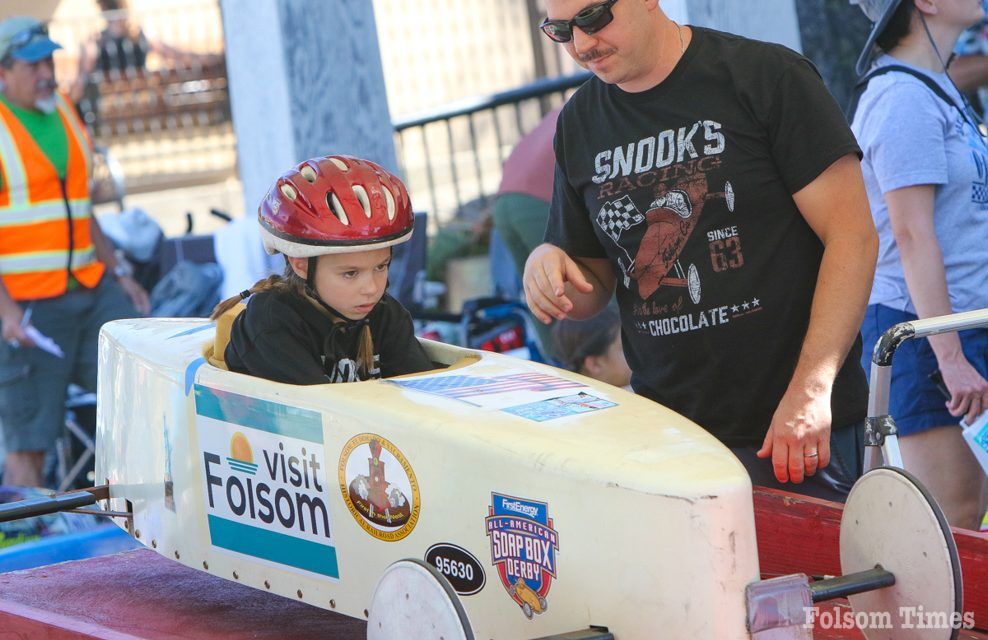
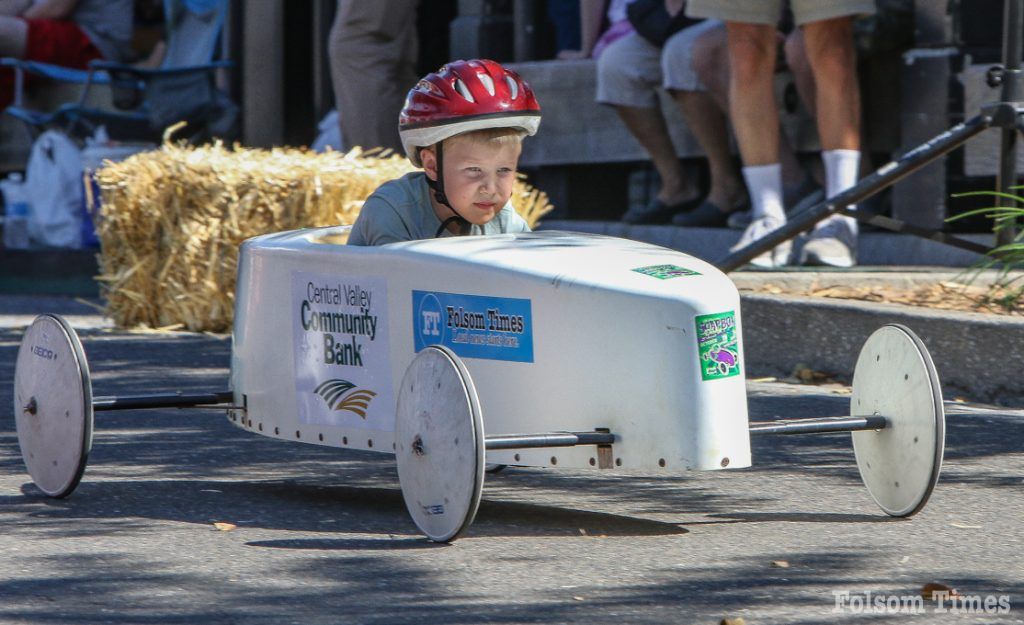
The Stock Division is the entry point for racers ages 7 to 13. Its lean-forward cars weigh approximately 70 pounds when assembled with racing wheels and can accommodate drivers roughly up to 5 feet, 3 inches tall and 125 pounds. The combined weight of car and driver cannot exceed 200 pounds, although racers below that limit can add weight to bring the combination closer to the maximum, according to the Northern California Soap Box Derby.
Stock cars arrive as kits, with builders typically spending four to six hours assembling them. Painting the Stock car’s white shell isn’t permitted under the rules, but racers can personalize their machines with decals or vinyl wraps, helping give each car its own identity as it comes down the hill.
The Super Stock Division expands the field to racers ages 9 to 18 and accommodates larger drivers, approximately up to 6 feet tall and 150 pounds. Those cars weigh about 73 pounds and have a maximum combined car-and-driver weight of 240 pounds. Like Stock, Super Stock uses a lean-forward design and generally requires four to six hours of assembly.
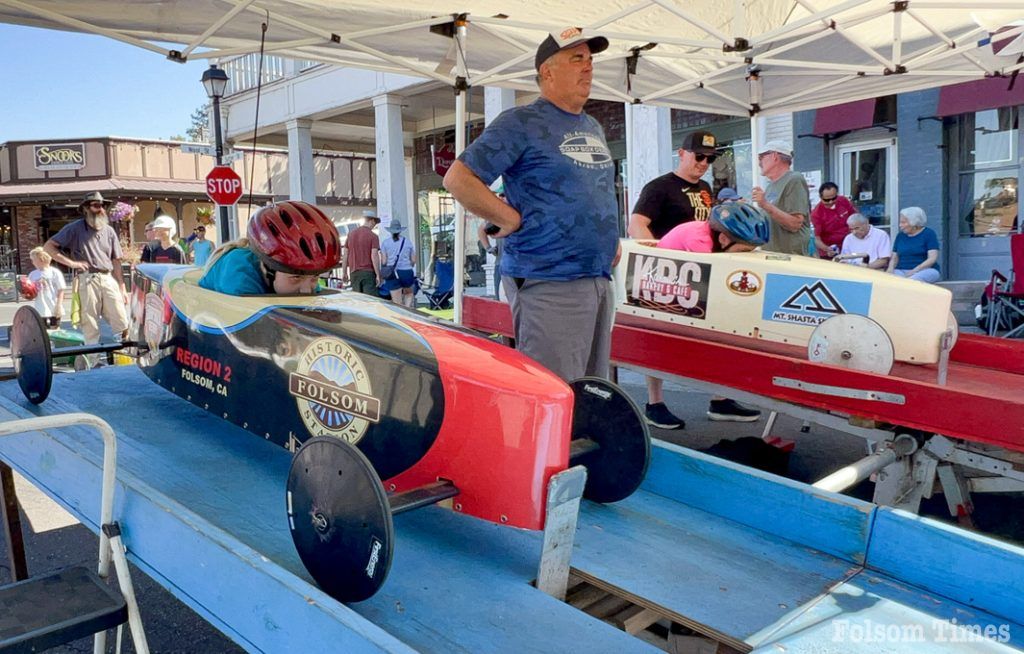
Then there are the Masters cars, which spectators should have little trouble distinguishing from the other divisions. Designed for more experienced racers ages 10 to 20, Masters cars use a low, enclosed, lay-down configuration that gives them the appearance of miniature purpose-built racing machines.
The cars weigh approximately 88 pounds with racing wheels and can accommodate drivers roughly up to 6 feet tall and 160 pounds. Maximum combined weight is 255 pounds. The Northern California organization notes that the enclosed design also allows smaller drivers to remain competitive in the division.
Weight is only part of the equation. Official race procedures include weigh-ins and wheel swaps between competitors. Racers exchange designated wheels with their opponent during competition, a rule intended to help ensure that differences between wheel sets don’t determine the outcome.
That means what appears from the sidewalk to be an uncomplicated trip downhill involves considerably more preparation and strategy than meets the eye.
For first-time racers, getting involved doesn’t necessarily require immediately purchasing a car. Northern California Soap Box Derby maintains club cars that newcomers can rebuild or adjust to fit a driver and use to begin racing. If a youngster decides to continue in the sport, experienced race families can help newcomers learn more about getting their own car and finding sponsors.
This weekend’s Folsom rally will feature Stock, Super Stock and Masters competition, with a double-elimination race Saturday followed by another Sunday. The Northern California organization lists the Folsom weekend as the opening event on its current Region 2 schedule, ahead of additional racing on the circuit.
Part of what has made Folsom’s rally distinctive is where it happens. Instead of an isolated racecourse, the cars descend through the middle of the Historic District, surrounded by restaurants, shops and spectators lining Sutter Street. The sound of wheels humming across pavement replaces the normal flow of vehicles as racers make their runs through one of the city’s most recognizable destinations.
The setting combines two eras of Folsom history: the Gold Rush character of the Historic District and a form of youth racing that became a fixture of American culture during the 20th century.
Folsom’s connection to soap box racing itself goes back much further than the current Sutter Street event. Youngsters were racing homemade gravity-powered cars locally as far back as the early 1950s, when East Natoma Street served as a racecourse. During Folsom’s 1953 Pioneer Festival, David Casten of Orangevale narrowly defeated Folsom’s Elton Ellis in one of the early races documented locally.
By the following decade, the sport had moved to Aerojet, where races were held on company property. In 1961, the local competition became a qualifier for international competition, connecting young racers from the Folsom area to a sport that had become a national phenomenon.
Soap box racing eventually disappeared from Folsom’s local calendar, but the idea of bringing it back survived. In 2018, local residents Karen Holmes and Mike McKernan began working to revive the tradition. Holmes, a member of the Folsom Historic District Association Board, had envisioned returning soap box racing to Sutter Street, while contact with the national organization in Akron, Ohio, helped connect Folsom to Northern California’s modern racing program.
Folsom officially joined the Northern California circuit as a race site in 2019. The regional organization’s history shows Folsom and Los Gatos were added that year, joining a program that had grown from earlier races in Vallejo and Mountain View into events throughout Northern California. Oakdale became another race venue in 2023.
Over the years, Folsom’s event has drawn competitors from well outside the immediate area, including racers from Washington, Utah, Southern California and the Bay Area. For some families, that means loading a soap box car onto a trailer and traveling hundreds of miles for a weekend in Historic Folsom.
“This Folsom race is very much on the radar of racers abroad,” Holmes told Folsom Times ahead of last year’s event. “It’s pretty amazing to see people’s reaction and excitement when they realize we are from Folsom, they immediately knew about the Folsom race.”
The broader Soap Box Derby tradition dates to 1933, when Dayton, Ohio, photographer Myron Scott saw youngsters racing homemade cars and helped organize a larger competition. The All-American Soap Box Derby followed in 1934, eventually establishing its national home in Akron.
By the middle of the 20th century, soap box racing had become part of American youth culture, with local champions advancing through competition and large crowds gathering for championship races.
Northern California’s modern organization grew from a similar grassroots effort. After youngsters from Palo Alto and Campbell competed in Vallejo in 2006, organizers developed a race closer to home in Mountain View. Racing later expanded to other Northern California communities, eventually bringing Folsom into the circuit.
Today, the Northern California Soap Box Derby operates as a licensed partner of the International Soap Box Derby, providing competitors ages 7 through 20 a pathway into organized gravity racing.
For many families, however, the attraction is less about where the sport might eventually lead and more about what happens along the way — assembling a car, learning how it works, making adjustments, meeting other racing families and finally seeing whether all that preparation pays off when the starting mechanism releases.
For spectators, virtually all of that preparation is condensed into a few seconds. A pair of cars sits at the top of the course as the drivers wait for the start. The cars are released, gravity takes over and the sound of wheels on pavement grows as two young racers chase the finish line with spectators cheering from along Sutter Street.
The Historic Folsom Fall Rally takes place Saturday and Sunday, Oct. 10-11, along the 700 through 900 blocks of Sutter Street in Historic Folsom. The event features Stock competition for ages 7 to 13, Super Stock for ages 9 to 18 and Masters for ages 10 to 20, with one double-elimination race scheduled each day.
Saturday’s derby also coincides with the regular Historic Folsom Farmers Market, giving visitors another reason to spend the morning or afternoon in the district.
For Folsom, the weekend represents more than another event on the fall calendar. A form of racing that local youngsters embraced more than 70 years ago has found a new home on Sutter Street, where today’s racers are taking on essentially the same challenge faced by the kids who once pointed homemade cars downhill on East Natoma Street — build the car, find the fastest line, trust gravity and see who gets to the bottom first.
More information about the rally is available through the Historic Folsom District Association event page. Racing divisions, rules and information for families interested in the sport are available through the Northern California Soap Box Derby.
Copyright © 2026, Folsom Times, a digital product of All Town Media LLC. All rights reserved. No portion of this publication may be reproduced, distributed, or transmitted in any form or by any means, without the prior written permission of the publisher.