New operational data details rapid inflows, controlled spills and downstream releases as Northern California water outlook improves
A succession of early January storms has pushed Folsom Lake into a strong midwinter position, with the reservoir reaching a key winter benchmark as federal operators carefully balance rising inflows, downstream releases and flood-control capacity across the American River watershed.
According to the U.S. Army Corps of Engineers, Folsom Lake reached an elevation of approximately 431.4 feet this week, placing the reservoir at 100 percent of its conservation storage level and about 55 percent of its total capacity by Wednesday morning. The lake currently holds more than 626,000 acre-feet of water. At full capacity, Folsom Lake can store up to 976,000 acre-feet, meaning substantial room remains for additional runoff as winter storms continue.
While the rapid rise marks a strong seasonal rebound, it does not represent a historic high. Folsom Lake’s all-time high elevation on record is 467.23 feet, reached on June 15, 1963, and while the reservoir has reached significantly higher levels on January 7 during historic wet winters such as 1997 and 2017—when lake elevations were already in the mid- to upper-450-foot range—the lake’s current elevation near 431 feet remains below the highest levels observed for this date.
Newly released operational data from the Bureau of Reclamation provides a clearer picture of how quickly conditions changed during the opening days of January. Between Jan. 1 and Jan. 6, inflows into Folsom Lake totaled more than 177,000 acre-feet, fueled by heavy rainfall, runoff and snowmelt from upstream basins. During the same six-day period, storage increased by approximately 82,400 acre-feet, reflecting the rapid accumulation of water following the storm sequence.
Lake elevation climbed steadily from 422.9 feet on Jan. 1 to more than 431.6 feet by Jan. 6. The most dramatic rise occurred on Jan. 4, when inflows exceeded 26,000 cubic feet per second and storage increased by more than 32,000 acre-feet in a single day as one of the strongest storm pulses moved through Northern California.
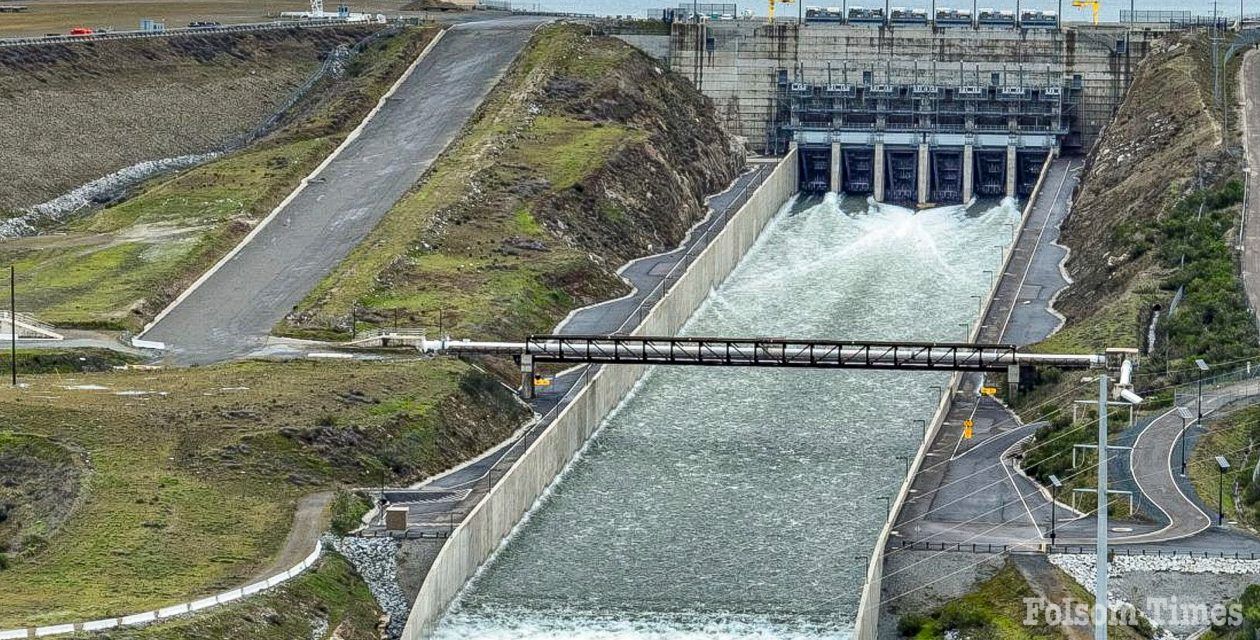
To manage the rapid rise in lake levels, dam operators increased releases in a controlled and incremental manner. Bureau of Reclamation data shows that more than 94,900 acre-feet of water were released during the first six days of January. The majority of that volume—about 58,300 acre-feet—was released through hydropower generation, while additional water was routed through controlled spill releases and outlet flows to maintain safe reservoir elevations and protect downstream communities along the American River.
Spill releases accounted for more than 29,000 acre-feet during that period, while outlet flows totaled roughly 6,700 acre-feet. Pumping plant operations continued at routine levels, reflecting standard system balancing. Despite the increased releases, inflows exceeded outflows overall, allowing the reservoir to continue rising while preserving critical flood-control space.
January precipitation at Folsom Lake reached just over 3.1 inches through Jan. 6, contributing to a seasonal total of nearly 25.8 inches since Oct. 1. Those local totals align with broader precipitation trends across Northern California, where many long-term monitoring stations are reporting rainfall totals well above average for this point in the water year.
Sacramento, the Sierra foothills and portions of the Bay Area are running between 125 percent and more than 175 percent of normal rainfall for early January. Blue Canyon, a key upper-watershed site feeding the American River system, has exceeded 170 percent of average precipitation to date, while South Lake Tahoe and other Sierra locations are reporting similar gains.
Even with the strong start, water managers caution that seasonal totals remain incomplete. Most Northern California locations have reached roughly half to two-thirds of their typical full-season precipitation, underscoring the importance of continued storms through late winter and early spring to fully rebuild reservoirs and groundwater supplies.
The improving conditions at Folsom Lake mirror recent snowpack findings highlighted in previous Folsom Times coverage. The Department of Water Resources reported that December storms marked a turning point for the winter season, delivering much-needed snow accumulation across the Sierra Nevada after a slow and warm start. That snowpack serves as natural storage, releasing water gradually into rivers and reservoirs such as Folsom Lake during spring and early summer, when rainfall diminishes.
Downstream from Folsom Dam, residents and recreation users along the lower American River are also seeing the effects of the increased water movement as releases pass through Nimbus Dam and into Lake Natoma.
Scheduled release information provided by the Bureau of Reclamation shows that flows through Nimbus Dam were adjusted multiple times during the opening days of January as operators responded to rising inflows from Folsom Lake. Releases into the lower American River were initially set around 5,000 cubic feet per second before being incrementally ramped higher over several days.
By the weekend, scheduled flows downstream of Lake Natoma climbed toward the 8,000- to 11,000-cubic-feet-per-second range as the watershed continued to absorb runoff from the storm sequence. Water managers rely on gradual increases to avoid sudden changes in river conditions while maintaining sufficient capacity upstream.
Those adjustments have direct implications for recreation and safety along Lake Natoma and the lower American River Parkway. Higher releases can produce faster currents, colder water temperatures and fluctuating water levels, prompting officials and river safety advocates to urge caution for paddlers, anglers and trail users during periods of elevated flow.
Lake Natoma functions as a regulating basin between Folsom Dam and the lower American River, helping smooth out variable releases before water continues west toward Sacramento. While it does not provide long-term storage in the same way as Folsom Lake, its role in daily operations is critical for balancing flood control, hydropower generation and downstream flow targets.
Water managers say Nimbus Dam releases will continue to be adjusted as weather systems move through the region and as Sierra Nevada snowpack conditions evolve. With Folsom Lake now at a key winter benchmark and significant space remaining before reaching its maximum capacity, the reservoir system is positioned to capture additional runoff while maintaining flexibility for flood management.
Taken together, the coordinated operations at Folsom Dam and Nimbus Dam reflect a broader strategy shaping Northern California’s water system this winter: capture as much runoff as safely possible, release water gradually to protect downstream communities, and position reservoirs and rivers to benefit from continued snowpack accumulation in the months ahead.
Copyright © 2026, Folsom Times, a digital product of All Town Media LLC. All rights reserved. No portion of this publication may be reproduced, distributed, or transmitted in any form or by any means, without the prior written permission of the publisher.