
The California Prison Industry Authority officially became the California Correctional Training and Rehabilitation Authority earlier this year, marking a rebranding that state corrections leaders say more clearly reflects the agency’s long-standing focus on rehabilitation, workforce development and successful reentry.
The name change took effect Jan. 1, 2026, following the enactment of Senate Bill 157 and Senate Bill 857. The former Prison Industry Board unanimously approved the change and has been renamed the Correctional Training and Rehabilitation Board.
The transition to CALCTRA was formally celebrated Tuesday with a ribbon-cutting ceremony attended by state corrections officials, labor partners, staff and program participants both present and past as well as multiple area media representatives. The special celebration emphasized that the change is not symbolic but rather a clearer public expression of work the agency has carried out for decades inside California prisons.
“This is the evolution of the dedicated work being done within this organization,” said Jeff Macomber, secretary of the California Department of Corrections and Rehabilitation and chair of the Correctional Training and Rehabilitation Board. “The new name reflects the heart of the mission.”

CALCTRA provides job-skills training for approximately 5,800 incarcerated individuals statewide through programs that offer industry-accredited certifications, hands-on work experience and sentence reduction credits. During opening remarks, Assistant General Manager Michele Kane said those programs deliver measurable public-safety outcomes while remaining cost-effective for the state.
“We save the state millions of dollars in California a year,” Kane said. She cited a recent study conducted by the University of California, Irvine showing that participants in the agency’s programs have a 15 percent return-to-custody rate within three years of release. “That means eighty five percent of CALCTRA participants stay out. They are doing well,” she said.
Macomber said those outcomes reinforce the importance of rehabilitation as the majority of incarcerated individuals eventually return to their communities. “We know that ninety five percent of our incarcerated go home someday,” he said. “And we know it’s important that folks return with the tools to be successful. That’s job skills, opportunity.”
He noted that people engaged in rehabilitative programming consistently demonstrate lower recidivism than those who do not participate, describing CALCTRA’s work as focused on preparing individuals for employment that is “actually marketable and employable upon release.” He pointed to career technical education, joint venture partnerships and apprenticeships as examples of training aligned with real-world workforce needs, including partnerships that allow some participants to secure job opportunities before leaving custody.
Macomber also placed the name change in the broader historical context of CDCR, referencing the department’s own transformation in 2005 when “rehabilitation” was formally added to its name. “Today, we gather for a similar alignment,” he said.
CALCTRA Acting Director Suzie Changus said the decision to move away from the former name was rooted in accuracy and clarity. “Words matter,” Changus said. “The words prison and industry do not convey that. Training and rehabilitation speak to the true intent of this agency.”
She described CALCTRA’s institutional workplaces as settings where individuals “experience a form of rehabilitation through their exposure in the institutional workplaces they elect to participate in with us,” adding that the agency’s purpose is to prepare participants to “return to their communities and gain meaningful employment upon the return to society.”
Changus emphasized that the mission depends heavily on staff across the state. “The people most responsible for helping fulfill this mission are the incredibly valuable staff of CALCTRA,” she said. “They bring our reason for being to life every single day.”
She added that the rebranding will help the public and partners more readily understand the agency’s role, noting that the previous name often required extensive explanation. Changus also announced expanded outreach efforts, including a new podcast titled “Prison to Purpose, Building Futures Behind Bars,” scheduled to launch Tuesday, Jan. 13, on Apple, Spotify and YouTube.
Career pathways and labor partnerships were highlighted in remarks by Kyle Patterson, a board member and regional manager for the Western States Regional Council of Carpenters. Patterson shared his personal journey from incarceration to a successful career in the construction trades, crediting rehabilitation, mentorship and training opportunities for changing the trajectory of his life.

“Words do have meaning,” Patterson said, describing how a pre-apprenticeship program helped open doors after his release. “It was bigger than me,” he said. “It’s a labor organization, the carpenters. Gave me an opportunity to start raising my family.”
Speaking directly to those currently in custody, Patterson said rehabilitation and career training offer tangible opportunity. “I’m no different than what you guys are going through right now,” he said. “I was in those seats right there.”
Retired General Manager Bill Davidson, credited by multiple speakers as the driving force behind the rebranding, described the name change as the culmination of a multi-year effort to more accurately define the agency’s mission.
Established in 1947 as the Correctional Industries Commission, the organization initially focused on agricultural and manufacturing work. In 1982, Senate Bill 1574 abolished the commission and created the California Prison Industry Authority as an independent entity governed by an 11-member board.
Davidson said the urgency for change crystallized in March 2023 after reading a news article that referred to a “prison industry furniture factory” at San Quentin. “When I read that prison industry furniture factory, nothing in that sounded positive,” he said. “Nothing in that sounded like what I knew our organization was about.” He said his reaction was immediate: “We need to change our name.”

Davidson detailed the roughly two-and-a-half-year process required to change a statutory name, secure stakeholder support and develop new branding. He credited CDCR leadership, the governor’s office and the agency’s project management team for moving the effort forward efficiently, adding that staff across the organization embraced the change more readily than expected.
He stressed that the new name does not diminish CALCTRA’s production work or the pride staff take in providing goods and services. “Nothing that we do, the correctional industry aspect of what we do, in no way is minimized or diminished by changing this name,” Davidson said. “Our mission is not changing at all in this name change.”
Looking ahead, Davidson encouraged participants to demonstrate the mission beyond prison walls. “Go home,” he said. “And as secretary said, not that we don’t wanna see you again, but if we see you again, we wanna see you like we see Kyle today.”
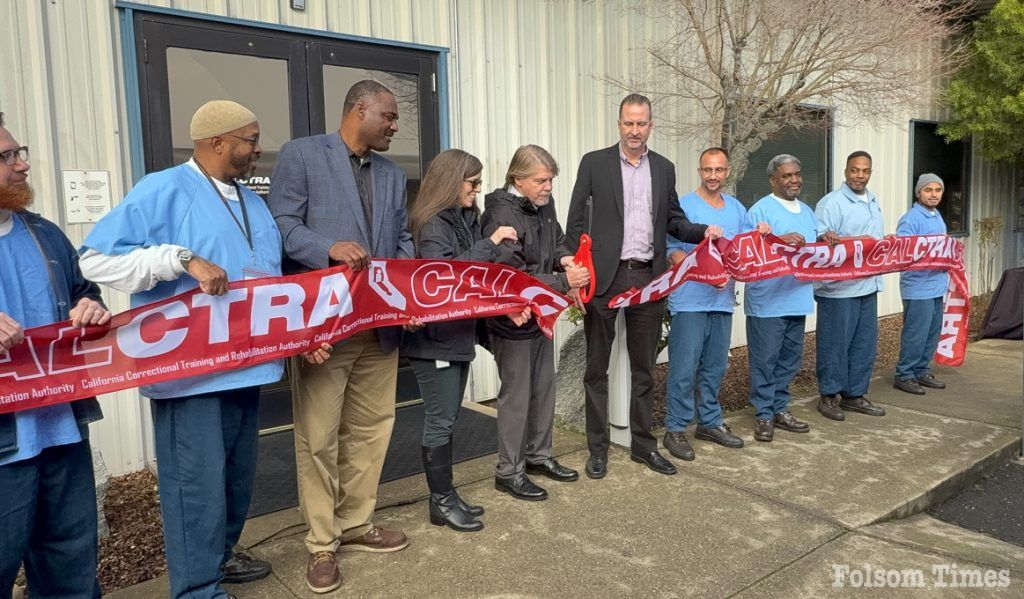
The ceremony concluded with a visible demonstration of the transition statewide. Organizers wrapped the event with a series of live streams from correctional facilities across California showcasing newly installed CALCTRA signage, then concluded locally with the unveiling of the updated sign on the hillside at the Folsom campus, formally marking the agency’s new identity.
Copyright © 2025, Folsom Times, a digital product of All Town Media LLC. All rights reserved. No portion of this publication may be reproduced, distributed, or transmitted in any form or by any means, without the prior written permission of the publisher.