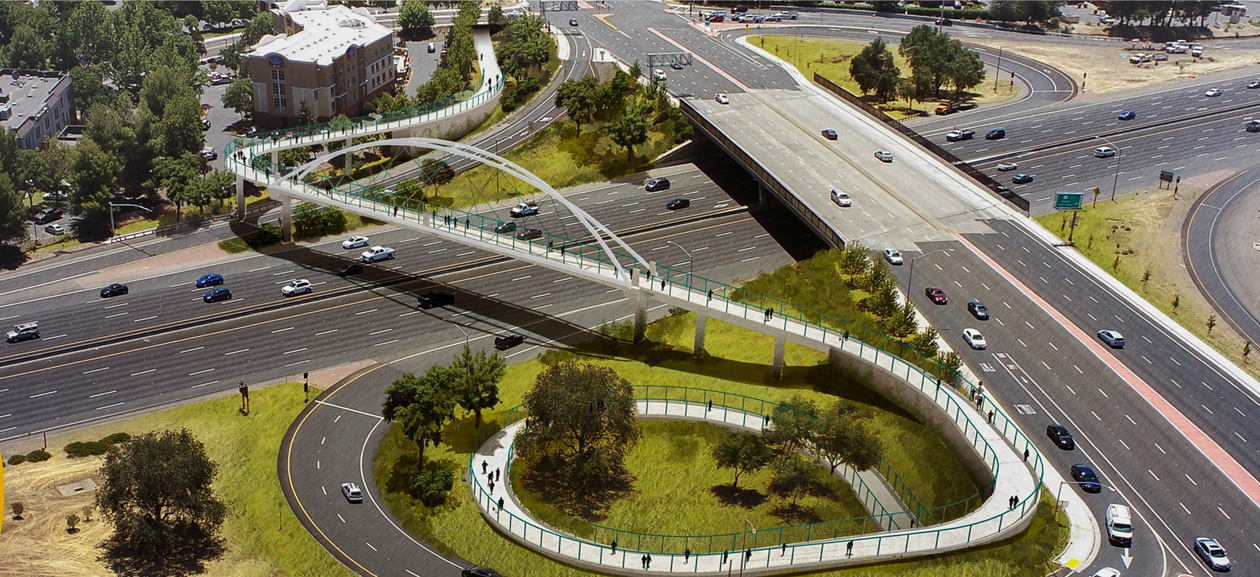
Council action for Zinfandel Drive overcrossing also includes $1.4 million public art program
The Rancho Cordova City Council has approved a $3.19 million construction management services contract to advance the Zinfandel Drive Bicycle and Pedestrian Overcrossing project, a Highway 50 pedestrian bridge backed by a $35,155,100 funding plan that also includes an integrated $1.4 million public art and Art Walk program planned along the bridge and trail corridor.
At its Feb. 2 meeting, the City Council adopted a resolution authorizing the City Manager to execute Contract No. 2025-277 with Ghirardelli Associates, Inc. for construction management services in an amount not to exceed three million one hundred ninety-two thousand seven hundred sixteen dollars and twenty-eight cents ($3,192,716.28). The approval represents a key procedural step as the city transitions the long-planned project from final design into active construction preparation.
City staff emphasized in the staff report that the $3.19 million figure does not represent the cost to build the bridge itself. Instead, the contract covers professional construction management services that support the project before and during construction, ensuring coordination, oversight, and compliance through project completion.
In addition to approving the construction management contract, the council received a comprehensive project update and took related actions authorizing artist agreements tied to the project’s Art Walk, wayfinding, and public realm components, which are designed to be constructed alongside the bridge rather than added after the fact.
According to the staff report, U.S. Highway 50 has long functioned as a barrier to alternative modes of transportation within Rancho Cordova, dividing neighborhoods on the north and south sides of the city. While vehicle crossings over the freeway exist, staff noted that safe and comfortable bicycle and pedestrian facilities are limited, often forcing cyclists and pedestrians to navigate areas near high-speed freeway on- and off-ramps.
“This Project will construct a bicycle and pedestrian facility along Zinfandel Drive from White Rock Road to Folsom Boulevard,” staff wrote. The completed facility is intended to improve multi-modal access and user comfort by removing the barrier to active transportation created by U.S. Highway 50 while improving connections to housing, employment centers, education facilities, and transit.
Staff further noted that the overcrossing is designed to directly reduce conflict points between vehicles, pedestrians, and bicyclists at Highway 50 on- and off-ramps and to improve safety conditions near Olson Drive, which has been identified as particularly challenging for non-motorized users under existing conditions.
The project is also intended to improve access to SacRT light rail stations along Folsom Boulevard, strengthening north-south connectivity and supporting regional transit use in addition to local travel.
The Zinfandel Drive Bicycle and Pedestrian Overcrossing has been under development for several years. In 2021, city staff initiated community outreach and presented multiple design alternatives to the City Council. Following review and discussion, the council selected a tied-arch bicycle and pedestrian bridge as the preferred alternative, establishing the direction for environmental review and engineering.
After selection of the preferred design, the project advanced through environmental analysis and preliminary engineering. In 2024, the City Council approved the project’s environmental documents, and the California Department of Transportation approved the project report, allowing the project to move into final design and right-of-way coordination.
The project is currently in the final stages of design review and approval by Caltrans, as portions of the bridge, trail, artwork, and signage will be constructed within Caltrans right-of-way. Construction is tentatively scheduled to begin in summer 2026, with completion anticipated in spring 2028.
According to the staff report, the project is backed by a $35,155,100 funding plan consisting of $11,822,100 in Traffic Mitigation Impact Fees, $3,377,000 in Federal Highway Improvement Program grants, and $19,956,000 in State Active Transportation Program funds. City staff noted that the project is included in the city’s adopted Capital Improvement Program and 2025–26 budget and does not rely on General Fund resources.
Alongside the bridge structure, the City Council also advanced the project’s Art Walk and supporting public realm improvements. A total of $1.4 million has been allocated for four permanent public art installations, community identification features, and wayfinding signage that are fully integrated into the bridge and trail design.
Staff noted that the City Council approved a comprehensive Art Plan for the project in August 2024. The plan calls for artwork and signage that function as gateways to and from the Zinfandel Drive overcrossing while reflecting Rancho Cordova’s identity at the crossroads of California geographically, historically, culturally, and commercially.
The Art Walk is designed as a sequential experience along the bicycle and pedestrian corridor, with installations encountered before, during, and after the Highway 50 crossing. One of the largest pieces, “Lichen Crossing” by artist Adrien Segal, will consist of a 100-foot-long mosaic tile wall near the Gold Center Drive undercrossing, depicting enlarged forms of fungi and lichen species documented in Rancho Cordova and integrated into a recessed portion of the pathway.
At the southern entrance to the trail near White Rock Road and Zinfandel Drive, artist Sheila Wyne’s “Tree Walker” sculpture will mark the beginning of the corridor and serve as a visible landmark for users approaching the bridge.
Additional installations are planned within Caltrans right-of-way near the Highway 50 ramps. “Passing Through,” a sculptural blue heron by artist Matthew Mazzotta, will be placed along the loop ramp area, while “Cascade” by artist Aaron Stephens will incorporate suspended illuminated elements intended to enhance visibility and user experience along the pathway during evening hours.
City staff explained that artists were selected through a competitive national request-for-qualifications process that attracted nearly 200 submissions. Review panels composed of arts professionals, community representatives, and city staff evaluated proposals and recommended finalists, who then refined their designs to address site conditions, safety requirements, and Caltrans regulations.
Three of the four artworks will be located within Caltrans right-of-way and are subject to the state’s transportation art review process. Under Caltrans guidelines, the city will be responsible for long-term maintenance, graffiti removal, and repairs, and ownership of artwork within the right-of-way will ultimately transfer to the state. Provisions allow the city to relocate or remove artwork should it later be determined to pose a safety concern.
The construction management services approved this week will support the project before and during construction. According to the staff report, responsibilities include constructability reviews prior to bidding, coordination with Caltrans and utility agencies, materials testing and inspection, schedule and cost oversight, and day-to-day field management once construction begins. These services are intended to ensure the project is delivered in accordance with approved plans, specifications, and regulatory requirements.
With environmental clearance complete, final design nearing completion, a construction management contract approved, and artist agreements authorized, the Zinfandel Drive Bicycle and Pedestrian Overcrossing project continues to advance toward construction as one of Rancho Cordova’s most significant active transportation and public realm investments.
Copyright © 2026, Folsom Times, a digital product of All Town Media LLC. All rights reserved. No portion of this publication may be reproduced, distributed, or transmitted in any form or by any means, without the prior written permission of the publisher.