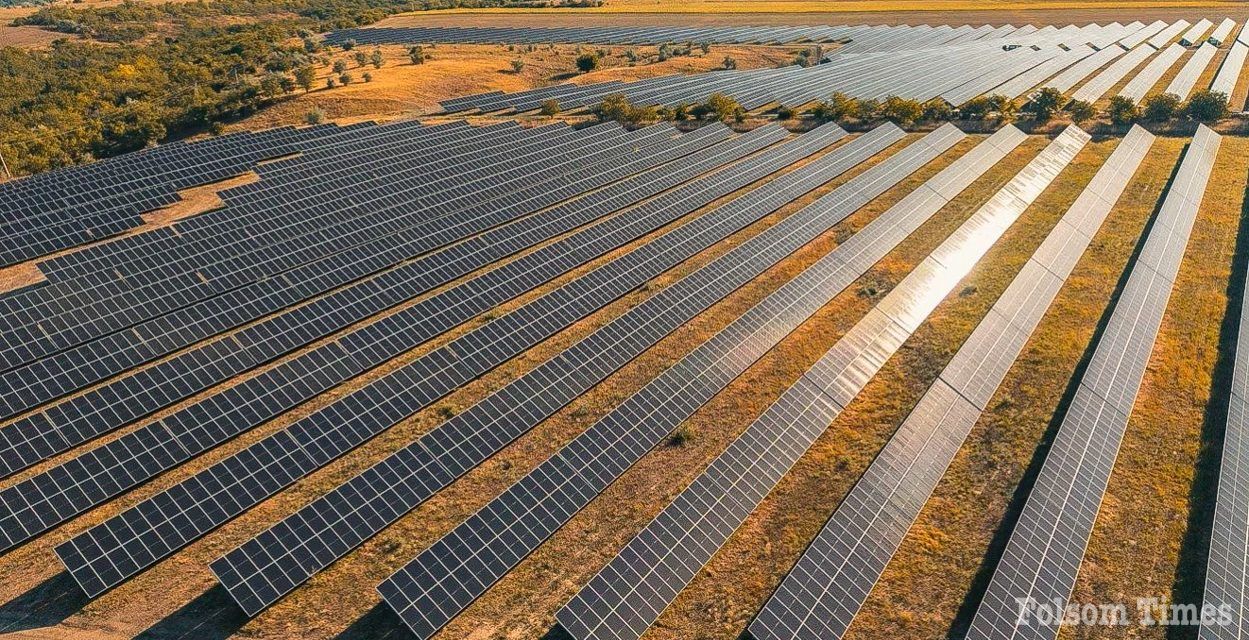
While the Sacramento Municipal Utility District has withdrawn from the proposed Coyote Creek Agrivoltaic Ranch project, the New York–based developer behind the controversial solar facility says it plans to continue moving forward under approvals already granted by Sacramento County.
D.E. Shaw Renewable Investments, known as DESRI, confirmed Wednesday afternoon that it will carry on with development of the project despite SMUD’s decision to cancel its power purchase agreement. The statement was first reported by the Sacramento Business Journal.
“We are moving forward with the development,” the firm said in the statement.
DESRI Chief Development Officer Hy Martin said the project remains positioned to advance county climate goals while preserving portions of the Barton Ranch site.
“The project is well positioned to permanently preserve extensive oak woodlands and wetland resources at Barton Ranch, generate meaningful property tax revenue, support local economic development, and advance the goals of the County’s Climate Action Plan,” Martin said. “We commend the Sacramento County Board of Supervisors for their bold leadership in unanimously approving the Coyote Creek Agrivoltaic Ranch last November.”
Sacramento County officials confirmed they are aware of SMUD’s withdrawal but said the county’s approval of the project remains intact.
“The project applicant may continue to explore additional off-take agreements consistent with existing approvals, so the County is still assessing the impact of SMUD’s decision,” said Ken Casparis.
As previously reported by Folsom Times, SMUD announced earlier this week that it had terminated its power purchase agreement signed in 2021, citing supply chain constraints, rising prices, tariffs, schedule delays, environmental impacts and pending litigation tied to the project. SMUD officials emphasized that the utility is not the project developer and does not control site selection or construction.
“Over the years, SMUD and DESRI have delivered multiple important clean energy projects that benefit our community, and we look forward to continuing our partnership for years to come,” SMUD CEO and General Manager Paul Lau said in a statement. “We remain committed to following a flexible pathway to eliminate all carbon from our power supply by 2030.”
The Coyote Creek Agrivoltaic Ranch is a 200-megawatt solar facility paired with a 100-megawatt battery storage system proposed on approximately 2,700 acres of the historic Barton Ranch in southeastern Sacramento County. The site lies just south of the Folsom city limits near the Prairie City State Vehicular Recreation Area and has been the focus of intense public debate.
Sacramento County supervisors unanimously approved the project in November 2025 following a public hearing that drew more than 150 speakers and hours of testimony. Supporters said the project would help meet clean energy mandates, provide locally generated power, create construction jobs and generate long-term tax revenue while incorporating agrivoltaics, including sheep grazing beneath solar panels.
Jaime Torres, a business representative with Laborers Local 185, spoke in support of the project during the hearing. “It’s a source of income for our members,” Torres previously said, adding that the project overall is “a wonderful resource for our environment… it’s a renewable source.”
Opponents focused on the project’s siting and environmental footprint, particularly the removal of thousands of mature oak trees and impacts to habitat and cultural resources. Jessie Dickson, a local botanist who operates social media accounts under the name @sacramentofoodforest, questioned whether the development could be considered environmentally beneficial.
“There’s nothing environmentally friendly about cutting almost 4,000 oak trees, the most ecologically valuable native tree in all of North America,” Dickson said. “Over 2,000 species depend on them.”
Luz Lim, a policy analyst for the Environmental Council of Sacramento, also opposed the project. “We think it is necessary to have solar development to reach our climate goals, but we also need to be strategic,” Lim said. “It doesn’t make sense that we are going to, in the name of green energy, kill thousands of blue oak trees, native trees, that have been here for a really long time.”
Supervisors described the decision to approve the project as difficult. District 3 Supervisor Rich Desmond called the vote “agonizing,” while District 2 Supervisor Patrick Kennedy said broader climate goals weighed heavily.
“We have to take actions that go beyond nibbling around the edges, while weighing sacrifices,” Kennedy said.
Tribal leaders also spoke against the proposal. “I’m here today to voice my opposition to the Coyote Creek solar project,” said Malissa Tayaba, vice chair of the Shingle Springs Band of Miwok Indians. “Should it move forward, it would result in irreparable harm and desecration to cultural resources, including village sites, burials, habitat for our plant and animal relatives, as well as the destruction of oak trees so critical to this unique cultural landscape.”
Following the county’s approval, environmental groups filed a lawsuit against Sacramento County in December 2025 challenging the project under the California Environmental Quality Act. The suit alleges the county approved a flawed environmental impact report that fails to adequately analyze and mitigate harm to oak woodlands, sensitive species, groundwater resources and nearby recreation areas.
“Make no mistake, this is not a choice between clean energy or irreplaceable habitat,” Lim said in a statement released with the lawsuit.
County planners acknowledged during the approval process that some impacts would remain unavoidable. “While most impacts are mitigated, three remain significant and unavoidable — aesthetics, cumulative oak woodland loss and tribal cultural resources,” Sacramento County associate planner Kimber Gutierrez said during the November hearing.
District 4 Supervisor Rosario Rodriguez, whose district includes Folsom and surrounding communities, later published a commentary explaining her vote in favor of the project. “The Coyote Creek project is a privately proposed large solar facility on rural land in southern Sacramento County,” Rodriguez wrote. “The County did not design the project, select the site, or set California’s energy rules.”
Rodriguez cited state energy mandates and electricity costs, writing, “If they are not met, the consequences fall on ratepayers in the form of higher electricity costs,” and said the vote “was about complying with those mandates in a practical way, not about making a symbolic statement about energy policy.”
She also stated that approximately 3,000 oak trees would be removed while more than 13,000 would remain on the property, that identified vernal pools would be avoided, and that substantial acreage would be permanently preserved.
Those seeking additional information about Sacramento County’s involvement in the Coyote Creek Agrivoltaic Ranch project can find project documents and updates on the county’s planning website by clicking HERE.Those looking for more information about the volunteer group organizing opposition to the project can visitwww.savecoyotecreek.com.
Copyright © 2026, Folsom Times, a digital product of All Town Media LLC. All rights reserved. No portion of this publication may be reproduced, distributed, or transmitted in any form or by any means, without the prior written permission of the publisher.