More to come after Folsom City Council unanimously approved land-use changes clearing path for FCUSD to make plans
FOLSOM — Long-term plans for school expansion in Folsom Ranch took a significant step forward earlier this month as the Folsom City Council unanimously approved changes that will allow the Folsom Cordova Unified School District to develop a combined, side-by-side middle school and high school campus in the growing planned community south of Highway 50.
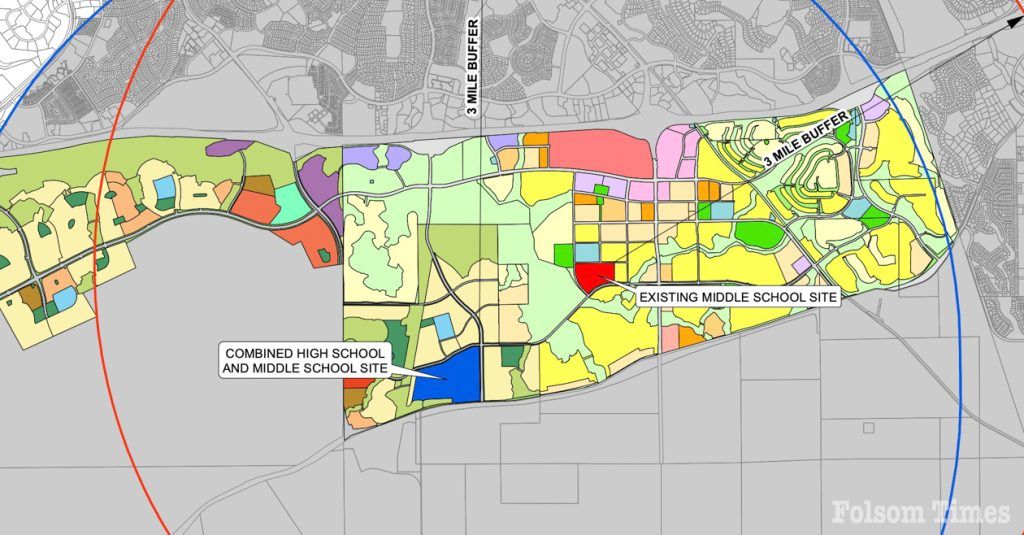
At its Dec. 9 meeting, the council adopted Resolution No. 11512, authorizing a minor administrative modification to the Folsom Plan Area Specific Plan that relocates a previously approved standalone middle school site and repositions it adjacent to the future high school site in the Alder Creek West area of Folsom Ranch. The decision follows years of evolving planning tied to escalating construction costs, site constraints, and long-range enrollment projections tied to one of the largest residential developments in the city’s history.
Folsom Ranch, also referred to as the Folsom Plan Area, is projected to add more than 31,000 residents to the city at full build-out over the coming decades. Based on student generation factors tied to housing types within the plan area, FCUSD has estimated the need for four elementary schools, one middle school and one high school to serve the community. Two elementary schools, Mangini Ranch and Alder Creek, have already been constructed in the eastern upland portion of the development at a cost of approximately $85 million each.
The next phase of school development, however, has proven more complex.Rising construction costs, which district officials estimate at roughly $1,000 per square foot, have pushed projected costs for the planned high school alone into the $400 million range, with the middle school estimated at approximately $250 million. Against that backdrop, FCUSD abandoned earlier plans for a standalone middle school at Mangini and Sierra parkways and returned to a combined-campus concept that was originally envisioned when the Folsom Ranch specific plan was adopted in 2011.
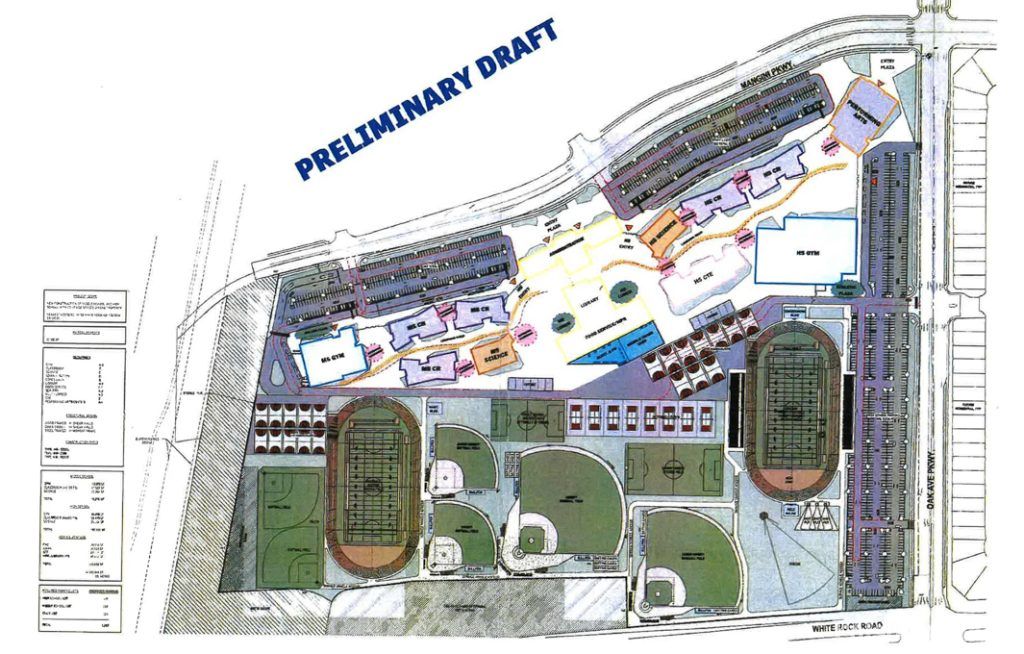
Under the approved modification, the existing 22-acre middle school site at Mangini and Sierra parkways will be redesignated for high-density single-family residential use, while a new 15.68-acre site adjacent to the future high school will be split into approximately 11.75 acres for public or quasi-public school use and about 3.93 acres for residential development,” according to the staff report and supporting documents presented last week. To maintain consistency with the overall residential unit count approved for Folsom Ranch, 89 dwelling units will be transferred between parcels, a process permitted under the specific plan through a transfer of development rights.
City planning staff emphasized that the modification does not increase the total number of housing units allowed in the plan area, does not alter the general land-use pattern approved by voters, and does not trigger additional environmental review under the California Environmental Quality Act. A traffic analysis and a vehicle miles traveled screening conducted by Kimley Horn concluded that existing roadway improvements planned for full build-out of Folsom Ranch would accommodate the shift in school location without creating new impacts, according to the staff report.
Presenting the item to the council, Principal Planner Jessica Brandt said the request met all requirements for a minor administrative modification under the specific plan and was consistent with both land-use and public services policies.
“A combined high-school/middle-school campus was actually originally proposed for the plan area,” Brandt said. “This returns to that model.”
Brandt noted that while the relocation moves the middle school farther west and away from the most central, walkable portion of Folsom Ranch, it remains within the plan area’s service radius and continues to meet district and state standards for school siting.
Craig Rouse, executive director of facilities development for FCUSD, told the council the district first began reassessing the original middle school site in 2017 after determining that access and topography issues would significantly increase development costs. At that time, the city approved a modification allowing the district to separate the middle and high school sites. In 2025, as planning advanced and costs continued to rise, the district revisited the idea of reuniting the two campuses.
“The original school site had limitations with accessibility and topography that made it too expensive to develop,” Rouse said. “That’s why we’re here tonight — for approval of the minor administrative modification.”
Rouse described the combined campus as physically connected but operationally separate, with distinct facilities, circulation paths and supervision zones for middle school and high school students. A joint administrative building would serve both campuses while maintaining clear lines of sight and separation to prevent unsupervised interaction between age groups.
“Even though they’re combined, they’re structured so they’re separate,” Rouse said. “Middle-school students and high-school students will be housed in separate areas with limited interaction.”
Beyond cost savings from shared infrastructure, Rouse said the model offers educational and operational advantages, including smoother transitions between grade levels, stronger collaboration among staff and access for middle school students to facilities that might otherwise be unavailable.
“Each grade transition creates exposure to more students and teachers,” he said. “The goal is to ease that transition and reduce anxiety while fostering a positive educational experience.”
Council discussion focused largely on campus design, athletics, traffic flow and student safety.
Councilmember Sarah Aquino questioned why schematic designs showed separate athletic facilities for the two schools if cost savings were a key benefit of the combined campus. Councilmember Mike Kozlowski responded that shared facilities often become overburdened, citing Vista del Lago High School as an example.
“There’s almost no time when they’re not in use,” Kozlowski said, adding that complementary facilities are increasingly necessary to support modern high school sports programs.
Kozlowski also suggested that, if possible, the district consider positioning the middle school track adjacent to the high school stadium to create a regional-quality venue capable of hosting track meets. He noted that Sacramento State University is currently the only nearby location with that type of configuration. Rouse said the district would take the suggestion under consideration.
Councilmember Barbara Leary raised questions about grade configurations, student separation and pickup and drop-off logistics. Rouse confirmed that middle schools in the district continue to serve grades six through eight and said each campus would have its own drop-off and pickup areas along the same street, operating at staggered times. Traffic controls, including potential signals or roundabouts, are still being evaluated in coordination with the city.
Public comment on the item was limited but supportive. Logan Martin Levinsky, speaking on behalf of Toll Brothers, which owns property adjacent to the planned school sites, said the developer supports the modification and has been working with the district on infrastructure alignment.
“Combining the two schools makes a lot of sense and we fully support it,” Levinsky said.
No members of the public spoke in opposition, despite staff acknowledging in the report that homeowners in the Mangini Ranch area may have purchased homes expecting to be within walking distance of the originally planned middle school site. With the relocation, some families may now need to drive students to school, though planners noted the availability of bike paths and pedestrian connections throughout the plan area.
Following discussion, the council voted 5-0 to approve the resolution, clearing the way for FCUSD to proceed with design and funding efforts.
Construction of the high school is tentatively scheduled to begin in 2027, with phase one of the middle school targeted for 2029. District officials emphasized that timelines remain dependent on housing growth, funding availability and broader economic conditions.
While years remain before students set foot on the new campuses, the approval marks the pivotal milestone in aligning long-term educational infrastructure with the scale and pace of growth planned for Folsom Ranch, along with budgetary concerns and rising construction costs.
Copyright © 2025, Folsom Times, a digital product of All Town Media LLC. All rights reserved. No portion of this publication may be reproduced, distributed, or transmitted in any form or by any means, without the prior written permission of the publisher.