I’ve heard from some of you about the Coyote Creek solar project, and I want to clearly explain what this project is, why the Board of Supervisors voted to approve the applications, and how I am responding to the concerns that have been raised.
The Coyote Creek project is a privately proposed large solar facility on rural land in southern Sacramento County. The County did not design the project, select the site, or set California’s energy rules.
The proposal came to the County after years of required environmental review, and the Board’s role was limited to considering the environmental review and deciding whether or not to approve the project. Our job was to decide whether this proposal met the legal standards required to move forward.
The legal context is important, because California has imposed strict energy source requirements on utilities and regions, including Sacramento County. If they are not met, the consequences fall on ratepayers in the form of higher electricity costs. As your Supervisor, my responsibility is not only to consider private property rights and environmental goals, but also to protect families who are already paying electricity rates that are roughly double the national average.
No one wants to see higher power bills. California electricity costs are the highest in the country. We want electricity that is reliable and affordable. The reality is that the state has set the rules, and counties are left to meet those requirements in ways that do the least harm and keep costs as contained as possible. This vote was about complying with those mandates in a practical way, not about making a symbolic statement about energy policy.
I also want to acknowledge that opposition to this project comes from several different perspectives, all of which I absolutely take seriously. Issues like rising electricity costs, skepticism of the effectiveness of solar power, removal of trees, impact on vernal pools, OVR recreation, and more. These concerns are not being dismissed. I will do everything in the power of my office to address these concerns and make changes where possible.
At the public hearing, there was a lot of confusion about what is actually happening on the land. Approximately 3,000 oak trees will be removed. But more than 13,000 oak trees on the property will remain, and large portions of the land will never be developed at all. All identified vernal pools are being avoided, and substantial acreage both within the project boundaries and surrounding the project is being permanently preserved. This is not a project that uses all of the land, and it is not accurate to suggest that everything is being cleared.
There has also been a lot of discussion about putting solar panels on rooftops or parking lots instead. While that idea sounds appealing, it does not address the scale of what is required. This project spans roughly 2,700 acres, which is more than half the size of the entire City of Citrus Heights.
Replacing something of that magnitude with rooftop or parking lot solar would require thousands of separate installations across hundreds of properties, major grid reconstruction, and decades of disruption, at a cost that would make the project collapse instantly and drive electricity rates even higher. That is why no jurisdiction anywhere has ever replaced utility-scale solar with rooftop solar alone. Experts in this field agree that rooftop solar is a supplement, not a replacement, for large-scale generation tied directly into the grid.
It is also important to be honest about what denial would mean. This is private property. The owner has been clear that the land is not economically viable as it exists today and that he needs to sell it. He does not want to see the property turned into housing sprawl and believes this project, with extensive on-site and off-site preservation, is the best option for his family, the community, and the environment. Denying the project would not freeze the land in time. It would simply push it toward other outcomes, many of which would permanently eliminate far more open space.
This vote was not about ignoring concerns or choosing ideology over people. It was about complying with state mandates, protecting ratepayers from even higher costs, respecting private property rights, and requiring mitigation and accountability where impacts are unavoidable.
I respect that not everyone will agree with this decision. But governing means making hard choices in the real world, where tradeoffs exist and the costs of inaction are borne by the public. That is the responsibility I take seriously, and that is how I will continue to approach this issue.
If you’d like to share your thoughts or concerns with me, you can always reach my office at 916-874-5491 or email me at SupervisorRodriguez@saccounty.gov.
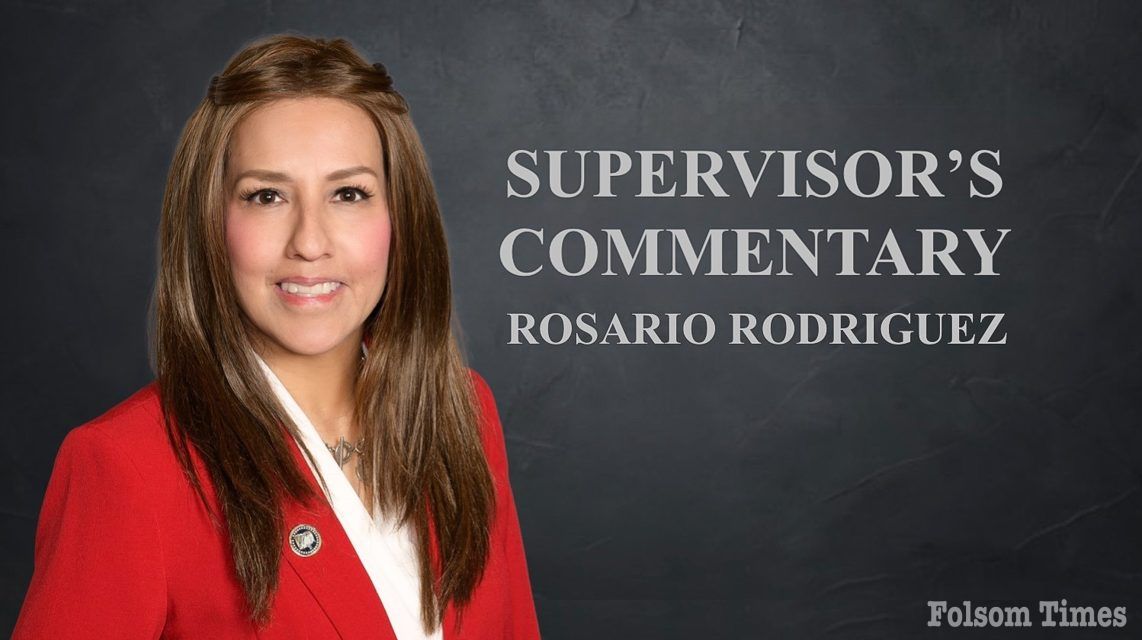
Rosario Rodriguez authored this community commentary. Rodriguez is the Sacramento County District 4 Supervisor, which includes the communities of Folsom, Rio Linda, Elverta, Antelope, North Highlands, Citrus Heights, Orangevale, Rancho Murieta, Sloughouse.
Copyright © 2025, Folsom Times, a digital product of All Town Media LLC. All rights reserved. No portion of this publication may be reproduced, distributed, or transmitted in any form or by any means, without the prior written permission of the publisher.