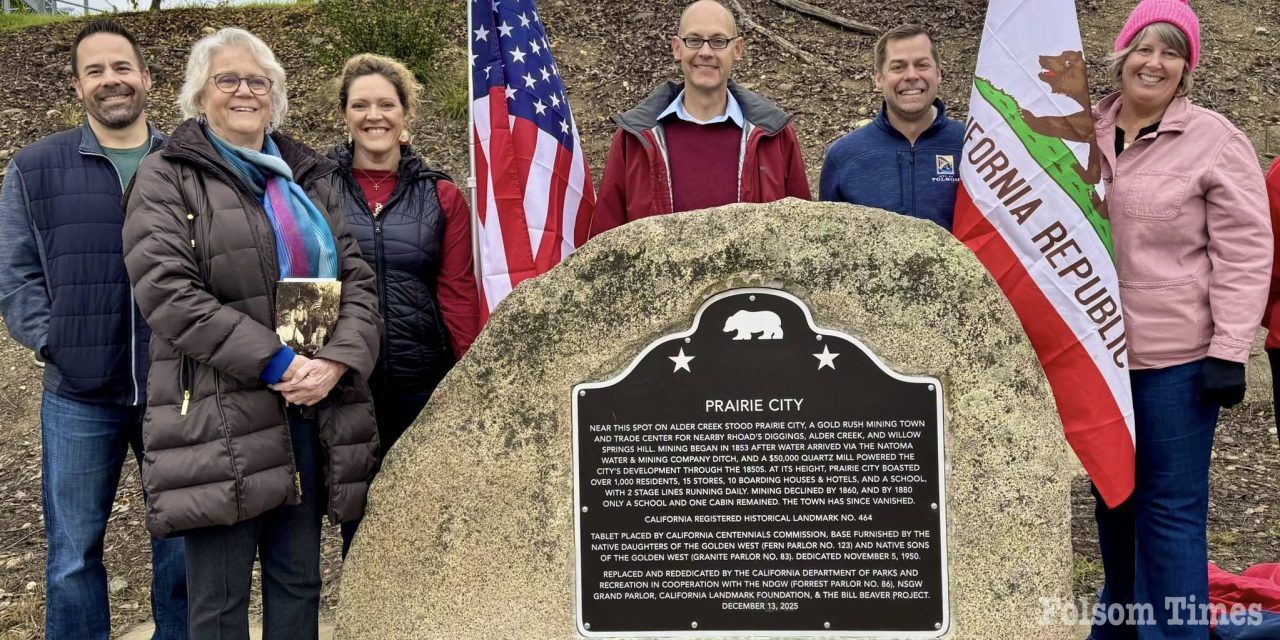
Replacement plaque honors vanished Gold Rush town near Folsom
FOLSOM — A piece of the region’s Gold Rush history was formally restored Saturday as city officials, historians, and community members gathered to dedicate a replacement California Historical Landmark plaque at the site of Prairie City, once one of the area’s most active mining settlements.
The ceremony, held Dec. 13 along Prairie City Road, marked the installation of a new state plaque honoring Prairie City, a Gold Rush-era community that played a significant role in shaping the early development of what is now eastern Sacramento County and Folsom. The original plaque, first placed at the site in 1950, had been stolen in recent years, leaving the landmark without its identifying marker.
The City of Folsom joined community partners for the dedication, celebrating both Prairie City’s history and the collaborative effort that led to the plaque’s replacement. Located just a few miles from Folsom, Prairie City was once a thriving settlement that served as a mining and trade center during the height of the Gold Rush.
According to the city, the effort to replace the stolen plaque began before Councilmember Barbara Leary was elected to the City Council and expanded over time. “It was initiated by Councilmember Barbara Leary prior to her election to the City Council. That early work grew into a collaborative, over-year-long project involving city staff, historical organizations, and dedicated volunteers, resulting in the restoration of this landmark so Prairie City’s legacy can continue to be shared with future generations,” the city said in a statement.
The California Landmark Foundation led the plaque replacement effort in partnership with the Native Daughters and Sons of the Golden West, The Bill Beaver Project, and the California Department of Parks and Recreation. The groups coordinated research, approvals, and fabrication to restore the official state landmark designation at the site.
The newly installed plaque recounts Prairie City’s rise and decline, noting that mining began in 1853 after water arrived via the Natoma Water & Mining Company ditch. A $50,000 quartz mill powered the town’s growth through the 1850s, and at its peak Prairie City was home to more than 1,000 residents, along with 15 stores, 10 boarding houses and hotels, a school, and two daily stage lines. Mining activity declined by 1860, and by 1880 only a school and a single cabin remained as the town disappeared from the landscape.
“Across California, thieves are stealing stories for pennies on the plaque, and it takes small, determined groups like these, fighting an uphill battle, to keep California’s history alive at the places where it happened,” said Kyle Jarrett of the California Landmark Foundation during the ceremony.
City officials said restoring the Prairie City marker ensures the site’s history remains visible and accessible to the public. With the new plaque in place, Prairie City’s legacy as a key Gold Rush-era settlement can continue to be shared with residents, students, and visitors for generations to come.
Copyright © 2025, Folsom Times, a digital product of All Town Media LLC. All rights reserved. No portion of this publication may be reproduced, distributed, or transmitted in any form or by any means, without the prior written permission of the publisher.